
At Health Care For All (HCFA), our fight for accessible, affordable and equitable health care in Massachusetts wouldn’t be possible without our community-based partner organizations. These groups have deep roots in various communities throughout the Commonwealth, and lead efforts to connect them with information, resources and social supports.
Here on HCFA’s blog, we’re excited to introduce you to some of the community-based organizations (CBOs) that have been at the heart of our work. We’re launching a new series called “Community Corner,” where we’ll share more about what CBOs do, their impact across Massachusetts, and their partnerships with HCFA. For the first installment, we sat down with Helena DaSilva Hughes, President of the Immigrants’ Assistance Center, Inc. (IAC) in New Bedford.
Thanks for taking the time to speak with us, Helena! For folks who are unfamiliar with the IAC, could you share a quick “elevator pitch” of what IAC does?
The Immigrant Assistance Center helps immigrants overcome language, cultural and economic barriers, and supports their integration into the mainstream community. That was our mission back in 1971, and it is part of our mission still today. One of our founders was a man who had come from the Azores in Portugal to the United States, and once he became successful and elected to the City Council he wanted to do something to help fellow immigrants who didn’t have any guidance. Today, we serve about 11,000 immigrants each year — around 40% are Portuguese speakers, 40% are Spanish speakers, and the other 20% are very diverse. They hail from around 65 different countries! And all nine of us working at IAC are immigrants ourselves.
And what kind of support do you provide these folks? What do they come in needing most?
These days, I would say most people are seeking out help with immigration questions. We have clients who are U.S. citizens, who are green card holders, who are in the process of applying for asylum, Deferred Action for Childhood Arrivals (DACA) recipients, kids with special juvenile visas, and people from families with mixed immigration status. We help them with emergency preparedness, like what to do if they’re picked up by ICE – in New Bedford, about 80 or 85 people have been picked up already. We’ve held 37 workshops with community members and service providers to help them understand their rights, how to avoid immigration scams, how to keep their children protected in case a caregiver is deported, and what their legal options are.
I can’t imagine how challenging this political environment must be for immigrant communities. How has all of this affected them?
These conversations are so, so difficult to have. Of course, many people are struggling with mental health. We see families afraid to send their kids to school, who avoid seeking medical care, or even to leave the house to get groceries. It’s so important for us at IAC to be someone they can trust.
IAC has partnered with HCFA on a number of campaigns to expand access to care, from medical debt to ongoing efforts to help MassHealth members navigate new federal work reporting requirements to maintain their health coverage. The trust that IAC has built within the communities it serves has been key for engaging them effectively. Can you tell me a bit about your outreach and support activities to connect immigrants with health coverage and services?
Helping people navigate basic needs like health care is so important to us! Each of our clients works with a case manager, whom we train to be Certified Application Counselors, or CACs, who guide people through insurance enrollment in their native language. We also do constant outreach in schools across the region. We utilize ethnic media, radio, television and social media to educate people about health insurance, and of course speak with people directly. We connect people with providers, or help mediate between them and our clients. We teach them about medical debt, and advocate for them to lower their bills.

IAC President Helena DaSilva Hughes and HCFA Director of Community Engagement Jamila Xible during a joint apperance on a Portuguese-language television program, discussing MassHealth and barriers to care.
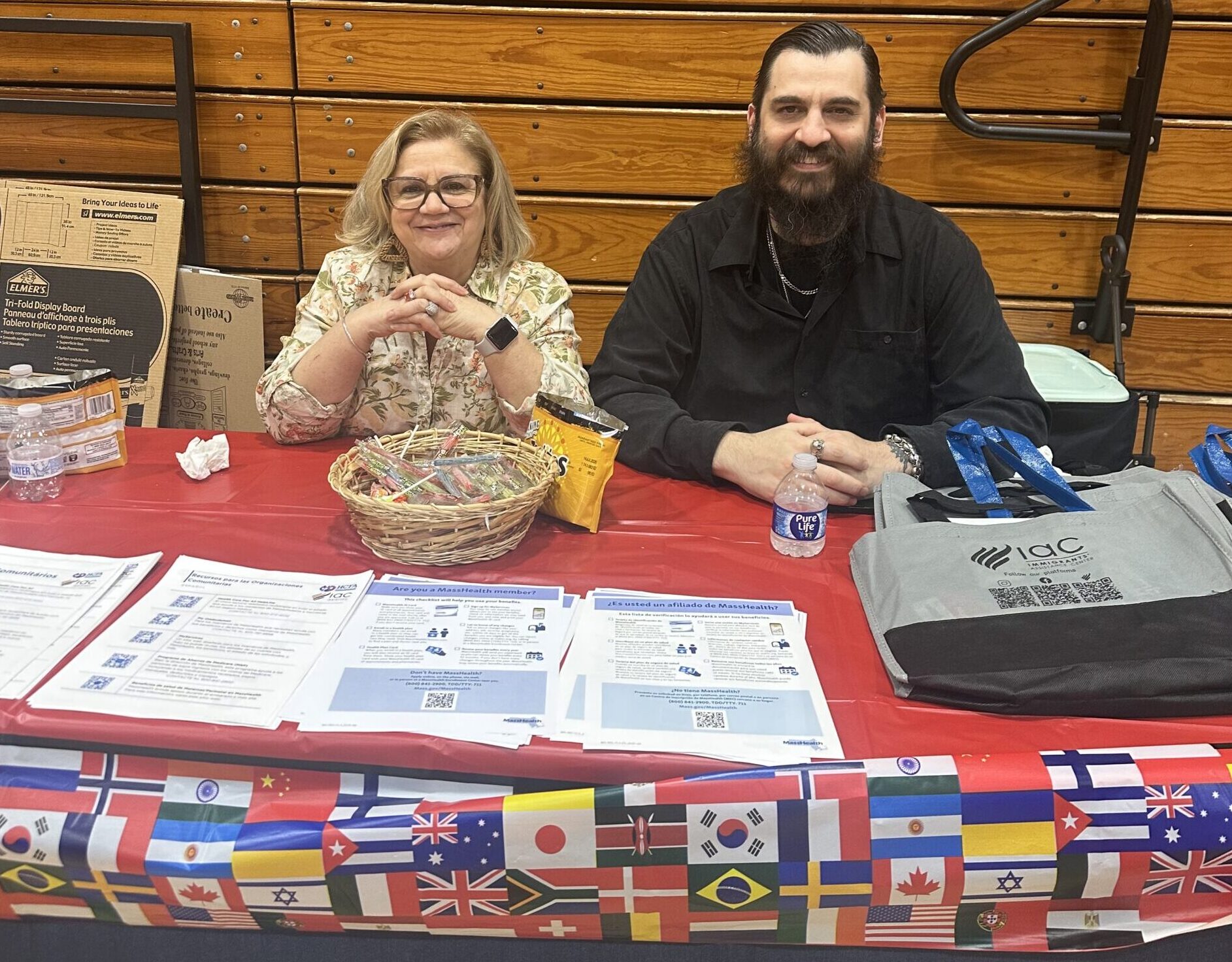
IAC staffers tabling at a community event held in a school gymnasium.
What has been most surprising about this work?
I think what stands out for me is a lot of times, a family thinks they won’t qualify for health insurance — but then we meet with them and do an assessment, and realize that yes, they do qualify for coverage. We get to tell them that, yes, you can get covered because you are pregnant, or yes, your young children qualify for comprehensive insurance. And that information can be such a relief to these families!
Unfortunately, many immigrants have recently lost coverage thanks to federal cuts. What can people reading this blog do to support immigrant communities in Massachusetts?
One of the things I always say is to listen and be kind. I think we all have so much more in common than not. I want people to better understand the journeys that families have taken to come to the United States, and the challenges they’re facing now. If we simply ignore what these families are experiencing, then anti-immigrant sentiment will get worse and force people further underground — and that really, really scares me.
Learn more about this week’s featured community-based partner Immigrants’ Assistance Center, Inc. at www.immigrantsassistancecenter.org.